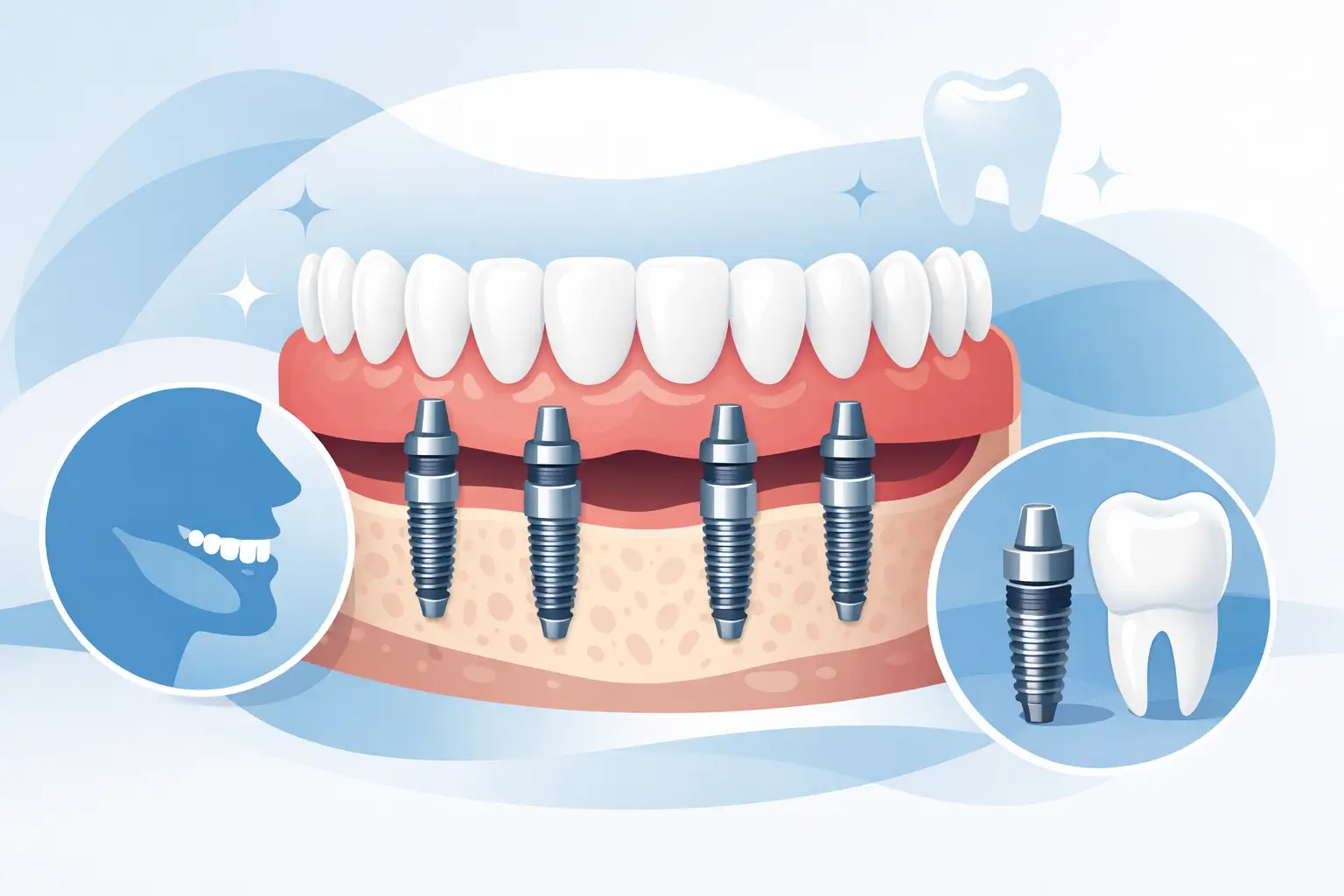
Losing most or all of your teeth changes more than your smile. It affects what you eat, how clearly you speak, and whether you feel comfortable laughing in a room full of people. For many adults researching a lasting solution, all on 4 dental implants- full teeth replacement option stands out because it can replace a full arch of teeth with fewer implants than traditional methods.
This treatment is designed for people who want more stability than removable dentures and a more complete restoration than replacing teeth one by one. It is not the right answer for every patient, but for the right candidate, it can restore function, appearance, and day-to-day confidence in a very meaningful way.
What is all-on-4 dental implants full teeth replacement option?
All-on-4 is a full-arch implant approach. Instead of placing an implant for each missing tooth, a dentist uses four strategically positioned dental implants to support a complete upper or lower set of replacement teeth. In some cases, more than four implants may be recommended depending on bone support, bite forces, or long-term treatment goals, but the concept remains the same: a full row of teeth anchored by implants.
The rear implants are often placed at an angle. This matters because it can help maximize contact with available bone and may reduce the need for bone grafting in some patients. That is one reason this approach has become a widely discussed option for full-mouth restoration.
For many patients, the biggest appeal is that the prosthetic teeth are fixed in place. They do not shift like traditional dentures, and they are typically far more secure when chewing and speaking.
Why patients consider all-on-4 over dentures
Traditional dentures still have a place in dentistry. They can be a practical and cost-conscious solution, especially for patients who are not ready for surgery or who need a shorter-term replacement option. But removable dentures also come with common frustrations. They may slip, rub sore spots, affect taste, or limit food choices.
That is where all-on-4 often feels like a major step forward. Because the teeth are attached to implants anchored in the jawbone, they tend to feel more stable and natural in everyday life. Patients often report being able to chew more comfortably and speak with greater confidence.
There is also a long-term oral health benefit to consider. Dental implants stimulate the jawbone in a way dentures do not. While no treatment can stop every change in bone over time, implants can help reduce the bone loss that often follows tooth loss.
Who may be a good candidate for all-on-4 dental implants
Adults who have lost most or all of their teeth, or who are facing extraction of failing teeth, are often the people asking whether this treatment makes sense. A good candidate usually has enough jawbone to support implants, healthy enough gums and oral tissues for healing, and overall health that allows for oral surgery.
That said, candidacy is not always simple. Some patients have bone loss, gum disease, uncontrolled diabetes, smoking habits, or bite issues that complicate treatment. None of those factors automatically rule out implants, but they do mean the planning needs to be careful.
This is why a full evaluation matters. Digital imaging, bite analysis, and a review of your medical history help determine whether all-on-4 is realistic, whether another implant design would work better, or whether preparatory treatment is needed first.
How the process usually works
The process starts with consultation and planning. Your dentist evaluates the condition of your teeth, gums, jawbone, and bite, then discusses goals, timing, and budget. If teeth need to be removed, that is included in the treatment plan.
On the day of surgery, any remaining damaged teeth may be extracted, the implants are placed in the jaw, and a temporary full-arch prosthesis is often attached. This immediate step is one reason many patients are drawn to the treatment. They can leave with teeth in place rather than waiting months with visible gaps.
Healing then begins under the gums and within the bone. Over the next several months, the implants integrate with the jaw in a process called osseointegration. Once healing is stable, the final prosthetic teeth are made and attached. The final set is stronger, more refined, and designed for long-term function.
Benefits of all-on-4 dental implants full teeth replacement option
The biggest benefit is stability. Fixed teeth allow many patients to eat a wider range of foods and avoid the daily inconvenience of removable appliances. That practical improvement can have a real effect on nutrition and quality of life.
Appearance is another major advantage. A well-designed full-arch prosthesis can restore smile symmetry, support the lips and cheeks, and create a more natural look than patients often expect. This is not just cosmetic. When facial support improves, people often feel more like themselves again.
Efficiency also matters. Compared with replacing every missing tooth with an individual implant, all-on-4 can provide full-arch replacement with fewer implants and, in some cases, fewer surgeries. That can make treatment more accessible and more streamlined.
The trade-offs patients should understand
This treatment has real advantages, but it is still surgery, and it comes with cost, healing time, and maintenance responsibilities. Patients should not think of all-on-4 as a quick cosmetic fix. It is a restorative procedure that requires planning and long-term care.
Cost is one of the biggest factors. While all-on-4 may be more efficient than placing many single implants, it is still a significant investment. Pricing varies based on extractions, sedation, imaging, materials, and whether one arch or both arches are being treated.
There is also an adjustment period. Even when surgery goes smoothly, patients may experience swelling, tenderness, and temporary diet restrictions. Eating with a new full-arch restoration can take practice. Speech may also need a short adaptation period as the tongue adjusts to the shape of the new teeth.
Not every case can avoid additional procedures. Some patients still need bone grafting, treatment for gum disease, or changes to the treatment design. Others may be better served by implant-supported dentures or a different full-arch approach using more implants.
What recovery is really like
Recovery is usually manageable, but it helps to have realistic expectations. The first few days are focused on rest, swelling control, and soft foods. Follow-up visits are important because your dentist needs to monitor healing and make sure the temporary prosthesis is functioning properly.
For a period of time, patients are often advised to stay on a softer diet to protect the implants while they integrate. That part can feel inconvenient, especially for people eager to get back to normal eating. Still, following those instructions matters. Too much pressure too early can affect healing.
Most people return to routine daily activities fairly quickly, but the full treatment timeline is longer than many expect. The visible part may happen fast, while the biological healing happens gradually.
How to care for fixed full-arch implants
One common misunderstanding is that replacement teeth do not need maintenance. They do. Even though the prosthetic teeth cannot get cavities the way natural teeth do, the surrounding gums and implant areas still need excellent hygiene.
Daily cleaning around the bridge and gumline is essential. Regular dental visits also remain part of the plan, since your dentist needs to monitor the implants, tissues, bite forces, and condition of the restoration. In a comprehensive practice such as Bountiful Dentistry, that ongoing care can be especially helpful because preventive, restorative, and long-term maintenance needs can be coordinated under one roof.
Patients who clench or grind may also need a night guard to protect the prosthesis. Small issues caught early are much easier to manage than larger mechanical problems later.
Questions worth asking at your consultation
If you are considering full-arch implants, ask how many implants are recommended in your case and why. Ask whether extractions, grafting, or sedation are part of the plan. It is also wise to ask what kind of temporary teeth you will wear, how long healing should take, and what maintenance will be required after the final restoration is placed.
You should also ask what alternatives make sense for your mouth. A trustworthy consultation does not push one treatment for everyone. It explains why a specific option fits your anatomy, health, goals, and budget.
Is this the right full teeth replacement option for you?
It depends on what matters most to you. If your priority is a removable, lower-cost solution, traditional dentures may still be the better fit. If you want fixed teeth, stronger chewing ability, and a treatment designed for long-term stability, all-on-4 may be worth serious consideration.
The right decision comes from a clear diagnosis, honest discussion of trade-offs, and a treatment plan built around your health rather than a one-size-fits-all pitch. If you are tired of loose dentures, failing teeth, or planning life around what your mouth can handle, a personalized implant consultation can give you a much clearer path forward.